India
Thiotepa price falls 91% as Centre's 30% margin cap hits cancer drugs
Manufacturers' revised MRPs under the trade-margin cap bring big relief on some chemotherapy drugs, but patented blockbusters like Keytruda have not budged.
Desh Flash desk30 October 2026, 7:50 pm IST2 minUpdated 30 October 2026, 7:50 pm IST
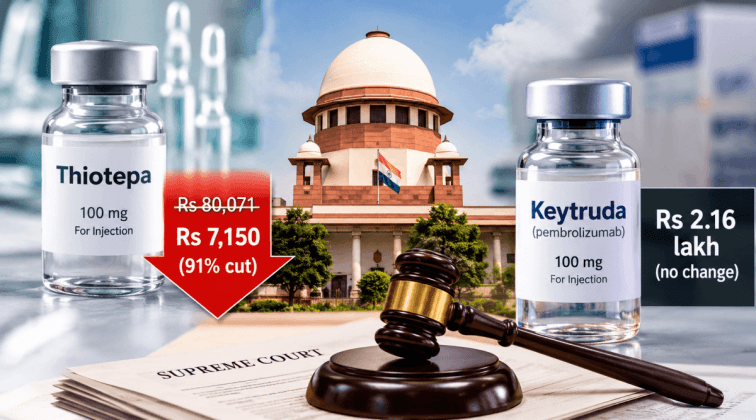
Cancer patients are seeing real price relief on some medicines after the Centre capped trade margins at 30% on 137 anti-cancer drugs. The steepest fall is in the chemotherapy drug Thiotepa. A 100 mg vial, sold as Samtepa by Samarth Life Sciences, drops from Rs 80,071 to Rs 7,150, a cut of about 91%.
Breast cancer treatment also gets a boost. Pertuzumab, sold by Glenmark as Hertumab, falls from Rs 94,951 to Rs 30,593 for a 30 mg vial, roughly 68% lower. The National Pharmaceutical Pricing Authority had expected reductions in a broad 20% to 70% band, depending on each product's existing margins and price structure.
The bigger picture is more mixed. According to figures cited from The Indian Express, the 137 drugs cover 543 formulations across brands and doses. Of these, 146 saw no price change and 21 fell by less than Rs 100. The average reduction across all formulations is a little over Rs 5,000.
The gap shows up at the premium end. Merck's Keytruda (pembrolizumab), used for lung cancer, breast cancer and other conditions, still costs Rs 2.16 lakh per 100 mg vial. Novartis's ribociclib, sold as Kryxana and Kisqali, also stays at Rs 24,435 for a pack of 21 tablets of 200 mg each.
The reason is market structure. A margin cap trims the mark-up between the manufacturer's first sale and the shelf price. It cannot do much for patented drugs with few or no generic rivals, especially when the first-sale price is already high. K M Gopakumar of the Working Group on Access to Medicines and Treatments said the new prices reinforce concerns that margin rationalisation alone may not make patented drugs affordable.
For now, the government expects MRPs on affected medicines to fall by up to 70%, saving patients about Rs 2,500 crore a year. The revised prices take effect on November 9, 2026. Manufacturers must file the new prices with the NPPA, and retailers and hospitals must charge them and display the updated rates. For hospital billing desks and pharmacy chains, that means a compliance scramble in the coming days.
The Supreme Court has also taken up the wider issue. On Tuesday, October 27, a bench of Justices Vikram Nath and Sandeep Mehta questioned the Centre about the large difference between what retailers pay for medicines and the MRPs patients are charged. The pricing debate is unlikely to end with this cap.
Source: IBTimes India
More in India
 India
Akka, Dhindora, Baththa lead Netflix India's 28–30 October streaming slate
 India
Gurugram razes 10 illegal RMC plants as winter dust crackdown begins
 India