India
Admiral Swaminathan Calls for Shared Indo-Pacific Ocean Research and Data Sharing
India's Navy chief says regional maritime security now depends on pooled scientific capacity, joint expeditions and stronger institutions across the Indo-Pacific.
Desh Flash desk5 November 2026, 2:35 pm IST2 minUpdated 5 November 2026, 2:35 pm IST
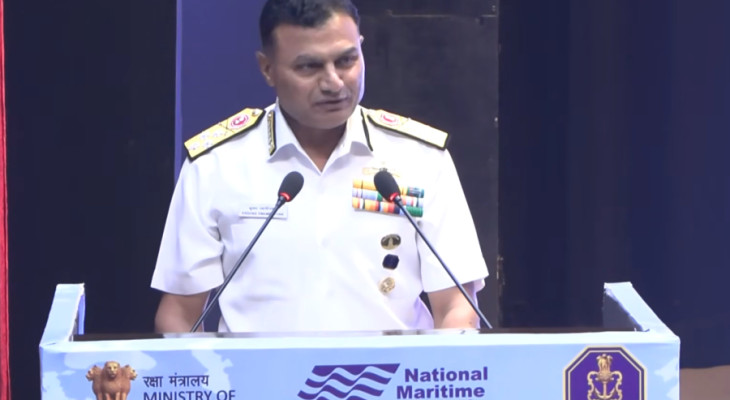
Indian Navy Chief Admiral Krishna Swaminathan urged Indo-Pacific countries on Wednesday to invest more in ocean science and to share research data and technology, arguing that maritime security now rests on collective scientific strength. He spoke at the Indo-Pacific Regional Dialogue (IPRD) 2026 in New Delhi.
His case rested on a set of pressures that do not respect borders. Rising sea levels, warming oceans, marine pollution and intensifying geopolitical rivalry all sit on the same maritime stage. Swaminathan noted that pollution drifts far from where it starts, and that changing rainfall patterns and stronger cyclones are hitting many coastal nations at once, so no single country can track these shifts alone.
He also put the stakes in economic terms. Oceans cover about 71 per cent of the planet's surface and hold roughly 90 per cent of its biosphere, he said. They support food security for more than three billion people, carry more than 80 per cent of global goods by volume and host the submarine cables that handle over 98 per cent of international internet traffic.
The sharpest part of his remarks was about inequality in research capacity. He said the annual median share of national research budgets going to ocean sciences is still below one per cent, and that just 10 countries operate close to two-thirds of the world's research vessels. The number of researchers per million people ranges from under 100 in some regions to more than 4,000 in others. He also warned that technology transfers often deliver equipment without the skills to run, maintain and upgrade it, which leaves recipients reliant on outside partners.
Swaminathan set out three priorities. The first is more investment in ocean research tailored to each country's needs, such as cyclone forecasting, coastal resilience, fisheries, seabed mapping and monitoring ocean conditions. He pointed to India's work in ocean forecasting and tsunami warning as proof that sustained funding produces practical gains for coastal communities and naval operations. The second is better sharing of oceanographic observations, climate models, seabed maps and marine environmental data, along with joint expeditions and pooled research. The third is stronger regional institutions to make that cooperation durable. He also argued for widening the usual STEM focus to STEAM, bringing in arts, design and creativity, on the view that complex maritime problems need interdisciplinary answers.
For investors, policymakers and coastal planners, the message is that ocean data is becoming shared infrastructure, much like ports or undersea cables. Whether the proposals move from speeches to agreements will determine how quickly the region can close its research gap. The full remarks are available at BW Businessworld.
More in India
Karnal Locks Down Key Roads Ahead of Amit Shah's Nov 5 Padyatra
 India
Delhi Traffic Police check 7,279 vehicles in a day as GRAP curbs tighten
 India