Economy
Harsh Madhusudan's Long India Makes the Case for Bullish Bets on India
A fresh batch of books pairs India's economic doubts with a playbook for business turnarounds, the hidden cost of data centres, and a light French detour.
Desh Flash desk1 November 2026, 8:45 pm IST3 minUpdated 1 November 2026, 8:45 pm IST
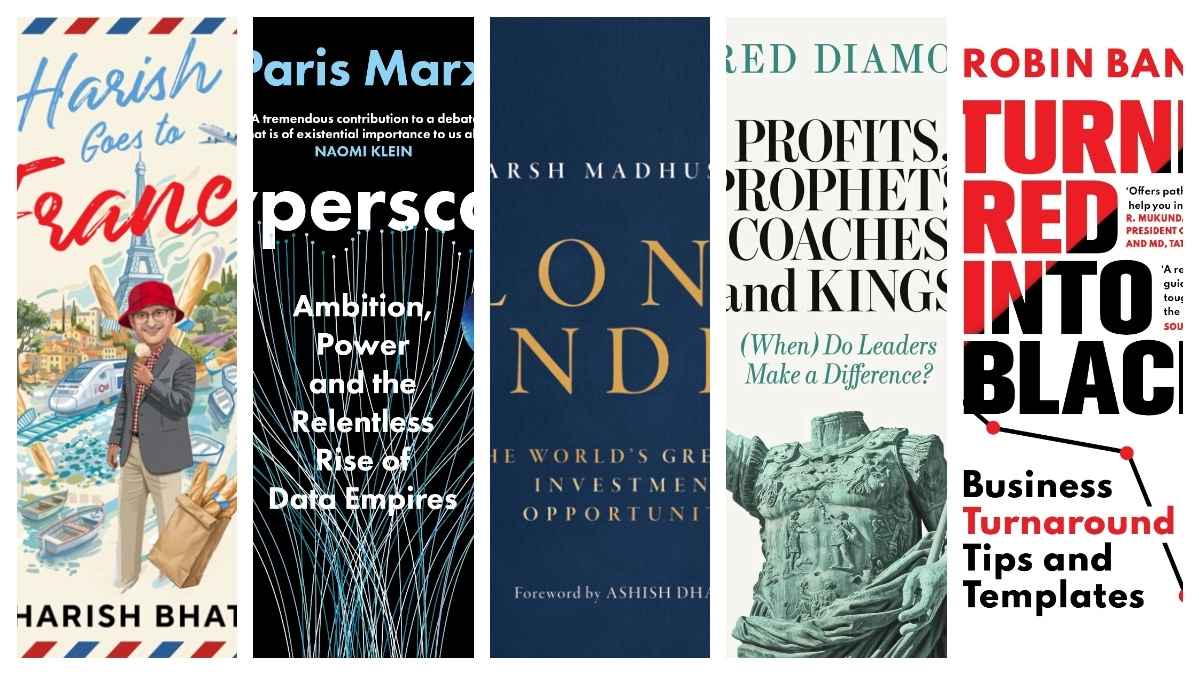
Harsh Madhusudan's Long India arrives at an awkward moment for the country's markets. The rupee has been sliding, foreign investors have been net sellers, and the goods trade deficit is widening. Madhusudan argues that India, already the world's fastest-growing major economy, remains the most attractive risk-adjusted investment available to global investors. It is a contrarian pitch, and it sits at the top of a new set of releases that stretch from boardroom rescue manuals to a travelogue.
The challenges the book confronts are familiar to anyone following the headlines. Artificial intelligence seems to be bypassing India's economy, cities are growing more congested, and political debate has grown louder. Many analysts also worry that the country could get stuck in the middle-income trap, where rapid early growth stalls before a nation reaches high-income status. Madhusudan's counterpoint is that the long-run arithmetic still favours patient capital.
For readers who want to see how companies climb out of trouble, Robin Banerjee's Turning Red into Black offers a practical lens. Published by Hachette, the 304-page book looks at turnarounds across industries and continents, from Steve Jobs's return to Apple to Nvidia's near-brush with running out of cash. Banerjee's core message is that a slump can be diagnosed and treated, and that a crisis can be turned into an opening rather than an ending.
Leadership gets a more skeptical treatment in Jared Diamond's Profits, Prophets, Coaches and Kings. Penguin Random House's 352-page release asks how much of any outcome can really be credited to one person, and how much is shaped by the conditions in which that person works. Diamond tests the question across politics, business, sport and religion, a framing that will be useful for investors and managers who tend to attribute results to a single charismatic chief executive.
The most urgent warning in the batch may be Paris Marx's Hyperscale. The cloud feels weightless, but it runs on sprawling server farms that consume land, power and water. Marx, also published by Hachette, follows the rapid expansion of data centres and argues that the physical footprint of the digital economy is growing faster than public attention to it. For a country racing to build digital infrastructure, the book is a reminder that the environmental bill comes due somewhere.
Lighter reading arrives in Harish Bhat's Harish Goes to France. Penguin Random House's 244-page travelogue follows the author from an invitation to Cannes through an unplanned tour of baguette varieties, French art and everyday encounters. It is a gentle counterweight to the economic and environmental weight of the other titles, and a reminder that the best travel writing often lives in small surprises.
Taken together, the releases offer a useful morning read for anyone tracking India's economy: a bullish macro thesis, a field guide to recovery, a critique of overreliance on heroic leaders, and a warning about the hidden costs of the digital boom. You can browse the full lineup and its details at the original Financial Express roundup.
More in Economy
 Economy
Karnataka launches Rs 5 lakh crore Navodaya 2047 plan with Bengaluru at core
 Economy
Mysore's Pre-Independence Development Push Gets a Fresh Look in Chandan Gowda's Book
 Economy
France protests: 320,000 march over living costs as Fitch turns negative on debt
 Economy