India
CDS Gen Subramani: India's maritime edge lies in adapting tech, not just buying it
Speaking at the Indo-Pacific Regional Dialogue 2026 in New Delhi, the Chief of Defence Staff urged self-reliance in critical capabilities, open systems and closer ties between the military, academia, industry and startups.
Desh Flash desk6 November 2026, 4:05 pm IST2 minUpdated 6 November 2026, 4:05 pm IST
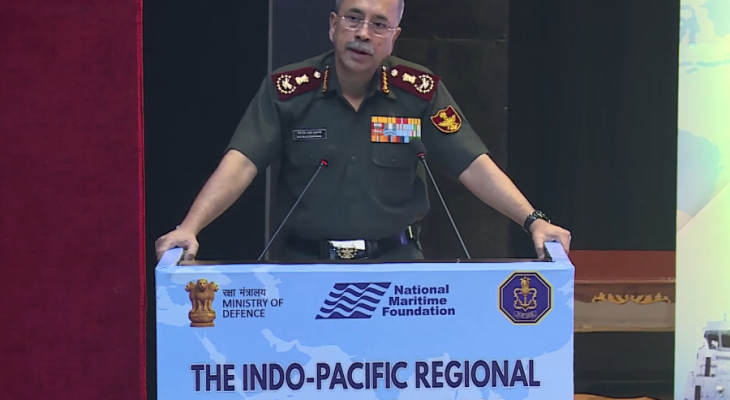
Chief of Defence Staff General NS Raja Subramani said on Thursday that the future of maritime security will turn on how well nations adapt, integrate and sustain new technologies, not on how many they acquire. Speaking at the Indo-Pacific Regional Dialogue (IPRD) 2026 in New Delhi, he also called for deeper technological self-reliance and stronger cooperation among Indo-Pacific countries.
The CDS listed artificial intelligence, autonomous systems, quantum technologies, advanced sensors, cyber capabilities and space-based assets as forces reshaping maritime power. In his words, the advantage will go to the nation that can adapt, learn and use technology, rather than the one that merely possesses it.
He also widened the definition of what needs guarding. Protecting ships, ports and harbours is no longer enough, he argued, because the digital infrastructure linking them is just as critical. He noted that over 99 per cent of communications travel through undersea cables, and warned that a disruption could leave most countries without communication.
For defence planners, and for the firms that supply them, the message is about networks as much as hardware. Subramani said modern platforms such as ships, spacecraft and autonomous vehicles derive their value from operating as connected systems that share information and produce coordinated effects. Planning, he said, should therefore cover the systems that link platforms across domains, not just the platforms themselves.
On self-reliance, he pointed to the Russia-Ukraine war, developments in the Black Sea and tensions in the Middle East and the Strait of Hormuz as evidence that a crisis in one region can quickly reach others. That, he said, strengthens the case for Atmanirbharta, though he stressed it does not mean isolation. Self-reliance, in his definition, is about building the critical capabilities India cannot do without, while building indigenous supply chains and working with trusted partners to secure access to key technologies during conflict.
He also cautioned against closed technological systems, which he said can create long-term dependence and stop different platforms from working together. He backed open-system architecture and standards, and described the goal as strategic autonomy supported by indigenous procurement and trusted partnerships.
The CDS closed with a pitch for tighter collaboration among the armed forces, research institutions, academia, industry and startups. Operational experience should steer scientific research, he said, and industry should work with researchers and military practitioners on solutions that can be produced at scale. He listed oceanographic research, maritime domain awareness, disaster preparedness, maritime safety and critical infrastructure protection among areas for cooperation. For India's defence-tech startups and manufacturers, the signal is that open standards and scalable, field-tested products are likely to be rewarded.
Read the original report at BW Businessworld.
More in India
 India
India U19 vs Nepal U19 at Under-19 Asia Cup: Oman opener preview
Karnal Locks Down Key Roads Ahead of Amit Shah's Nov 5 Padyatra
 India
Admiral Swaminathan Calls for Shared Indo-Pacific Ocean Research and Data Sharing
 India